This blog examines how disparate cultures collide, cross pollinate, enervate, and synthesize new cultures. Extraordinary and fresh innovation and ideation often occur at the intersection of traditionally orthogonal disciplines, be they music, literature, architecture, advertising and other forms of media.
Saturday, November 16, 2013
Kleber Mendonça Filho's Neighboring Sounds has Precedent
Brazilian film maker Kleber Mendonça Filho filmed Neighboring Sounds (2012) on a street in Setúbal, a nouveau-riche area where he grew up in Recife. It is a fascinating look at modern Brazilian society in regards to race, paranoia about security and violence, land rights, and relations.
More than half the street's buildings are owned by patriarch Francisco Oliveira (W. J. Solha), who got rich running a sugar mill in Bonito. Flashbacks of the plantation open the film. Don Francisco’s foreign-educated nephew João (Gustavo Jahn) is a bored realtor who shares center stage with also-bored housewife Beatriz ‘Bia’ Linhares (Maeve Jinkings). Clodoaldo (Irandhir Santos) shows up with buddies to offer private night security for the neighborhood, but have a secret motive revealed in the film's penultimate scene with Francisco, Clodoaldo, and his brother (SPOILER ALERT !). Apparently in 1984, Francisco snuffed out the boys' father on the sugar plantation, and the brothers return the favor. This act of revenge slowly builds over two hours of the film. Sight & Sound 's Tony Rayns comments "It’s quite a daring stratagem to spring such a narrative surprise in a film’s closing moments."
The director (in a voice over) mentions his distaste for close-ups so typical of spaghetti westerns. Yet the parallels of this film and Leone's Once Upon a Time in the West (1969) are uncanny. Both films are based on contested land rights (water for steam trains contingent on construction of a train station and large sugar plantations). Both films involve a long delayed revenge involving brothers, revealed in both films in the penultimate scene. And Solha looks so much like Jason Robards !
Tuesday, November 5, 2013
NYU Film major captures uncanny relation in Starlet
Starlet (2012) stars Dree Hemingway (yes, the grandaughter) and Besedka Johnson in an improbable relationship in the San Fernando Valley, best known as a porn Mecca (good oxymoron). It is directed by Sean Baker, an NYU Film Studies graduate. Johnson was discovered at a Hollywood YMCA at age 85. She died April of this year.
Wednesday, August 28, 2013
Rust and Bone Makes a Big Splash
Rust and Bone (2012) is the ultimate collision between (wo)man and beast. Stéphanie (Marion Cotillard, Academy Award winner for her lead as Édith' Piaf in La Vie en Rose (2007)), orca trainer, becomes a snack for one killer whale as she donates her legs in a freak accident at poolside. Her recovery takes an interesting course as it develops through an increasingly romantic relation with Belgian Ali (Matthias Schoenaerts), a masochistic kickboxing bare-knuckle street fighter who settles with his son Sam in Antibes on the Côte d'Azur near the French border with Italy. French director Jacques Audiard removes any traces of glamour in Antibes as the camera focuses on a gritty blue-color life. The acting is exceptional in a beautifully constructed movie about very unlikeable people with damaged souls and battered bodies. The friends-with-benefits relation morphs into something less animalistic.
The film’s title, Rust and Bone, refers to the taste of blood in the mouth when, upon a blow to the face, the lips are crushed against the teeth. It is also the title of a collection of short stories (in particular Rocket Ride) by the Canadian writer and amateur boxer, Craig Davidson, which was very successful when it was first published back in 2005. The violence of Ali's bouts is exciting to Stephanie in a disturbing fashion. Audiard's films show a fascination with the world of the voyou or thug. Killough (purefilmcreative.com) opines a thug is dangerous in a purely brutal way, whereas the voyou's danger may be life threatening, it is also perversely seductive.
The digital effects are out of the ordinary as they create a legless actress rather than assisting wizards, monsters or superheroes. The significance of her tattoos (DROITE and GAUCHE with reversed Es) is again part of boxing lingo. In French, une droite means a right punch in face, une gauche a left.
When Sam falls through the ice on the skating pond, Ali is willing to break his own hands to break the ice and save him. The human hand has 27 bones, broken hands never fully heal, so we are told at the film's conclusion through a voice over when Ali holds Sam's hands.
The soundtrack is excellent especially in the trailer, utilizing Antibes native band M83's "My Tears are Becoming a Sea" off their Hurry Up, We're Dreaming album.
Friday, July 19, 2013
Happy Together Characters are Not Even Close
Typical of Wong Kar-Wai's films, this film (1997) lacks any real narrative beyond a gay pre-handover Hong Kong couple seeking to invigorate and renew their rocky relationship with a vacation to Iguassu Falls in Argentina. Ho Po-Wing (Leslie Cheung, poster left) and Lai Yiu-fai (Tony Leung, narrator, poster right) exhibit a pattern of abuse followed by break-ups and reconciliations. Ho is self destructive and cannot maintain a monogamous relationship. Unfortunately, they run out of money and cannot return, getting odd jobs in Buenos Aires. The Turtles' classic 1967 "Happy Together" plays over the credits, covered by Danny Chung. Clearly the title is sarcastic at best. But it has another meaning.
We learn later that Lai had stolen money from his father to finance the trip. He writes his father to pay it back. These acts of reconciliation between past acts and the present time underpin the second meaning of Happy Together.
Ultimately, Lai visits the waterfalls before returning to Hong Kong. The opportunity to renew their love in an exotic local is a youthful fallacy. Stephen Holder (NYT, 10/10/97) observes that Elizabeth Hardwick in her book Sleepless Nights, opined "When you travel, your first discovery is that you do not exist." The movie is pervaded by the sense of isolation when you travel. At one point Lai narrates "I understand he can be running around because he has a place he can return to," in regards to his friend Chang. The implication is that Ho and Lai do not.
Sunday, July 14, 2013
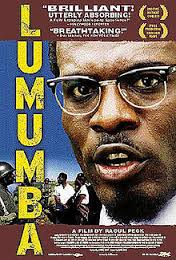
Haïti and Zaïre linked in Peck's Lumumba
Haïti and Zaïre share more than an umlaut. They share a common language and a long history of suffering under sovereignty. Specifically, they share Raoul Peck, a Haïtian director of the Belgian film Lumumba (2000), featuring the 2 month reign of Patrice Lumumba, before he was "disappeared" by the CIA. It was filmed in Zimbabwe and Beira, Mozambique. Lumumba's comrade-in-arms, Mobutu, would take over and rechristen the DRC as Zaïre.
Apparently, the Belgian Congo and subsequent Democratic Republic of the Congo felt it would be a wise decision to recruit French-speaking professionals from Haïti, since the Belgians had done little to create leadership from within the Congo native population. Born in Port-au-Prince in 1953, Raoul joined his father in Léopoldville at 8 years of age, shortly after independence in June, 1960. Peck attended schools in the DRC (Léopoldville), in the United States (Brooklyn), and in France (Orléans), where he earned a baccalaureate, before studying industrial engineering and economics at Berlin's Humboldt University. He spent a year as a New York City taxi driver and worked (1980–85) as a journalist and photographer before attending and receiving a film degree (1988) from the German Film and Television Academy Berlin (DFFB) in West Berlin.
Watching the film, I could not get over parallels between Lumumba and Aristide, both popularly elected and at odds with the U.S.
Wednesday, July 10, 2013
Heavenly Voices Eerily Similar in Chinese, Indian films
These are two profoundly beautiful films with truly extraordinary soundtracks. Celebrated Director Zhang Yimou's Flowers of War (2012) features lyrical coloratura soprano Chen Xiaoduo and the Allmänna Sången Choir (founded in 1830 in Uppsala, Sweden) in a song called "Heavenly Voice." Listen to it here. Danny Boyle's Slumdog Millionaire (2009) featured India's top female vocalist Suzanne D'Mello on Latika's Theme. Though structurally different, these two theme songs are eerily resonant.
Thursday, July 4, 2013
California Dreamin' Informs Chungking Express
The Mamas & the Papas classic song California Dreamin' resonates in Hong Kong director Wong Kar-wai's film Chungking Express (1994). WKW was heavily influenced by French New Wave (Truffaut, Godard, Rohmer, etc.) and it shows in the free form disregard for plot structure of his oeuvre and the emphasis of style over psychology. This film, in the form of a diptych (two stories) filmed entirely within the claustrophobic confines of Hong Kong's infamous city-within-a-building housing debacle, Chungking Mansions (built in 1961) stars the Garboesque Brigitte Lin (who retired after this film) and Faye Wong (her first film, now a HK pop music star) who "performs" (her arms flailing behind the counter of the Midnight Express takeaway bar) a Cantonese cover version of The Cranberries' Dream. The frequent pop culture references are reminiscent of the short stories of Japanese writer Haruki Murakami. California Dreamin' is recognizable to a global audience and commoditized as such. Even the Del Monte pineapple tins are exemplars of American culture.
The film is about alienation and loneliness, paradoxical in that 4,000 tenants are crammed into the residence.
Subscribe to:
Posts (Atom)