Friday, July 19, 2013

Happy Together Characters are Not Even Close

 
Typical of Wong Kar-Wai's films, this film (1997) lacks any real narrative beyond a gay pre-handover Hong Kong couple seeking to invigorate and renew their rocky relationship with a vacation to Iguassu Falls in Argentina.  Ho Po-Wing (Leslie Cheung, poster left) and Lai Yiu-fai (Tony Leung, narrator, poster right) exhibit a pattern of abuse followed by break-ups and reconciliations.  Ho is self destructive and cannot maintain a monogamous relationship.  Unfortunately, they run out of money and cannot return, getting odd jobs in Buenos Aires.  The Turtles' classic 1967 "Happy Together" plays over the credits, covered by Danny Chung.  Clearly the title is sarcastic at best.  But it has another meaning.
 
We learn later that Lai had stolen money from his father to finance the trip.  He writes his father to pay it back.  These acts of reconciliation between past acts and the present time underpin the second meaning of Happy Together. 
 
Ultimately, Lai visits the waterfalls before returning to Hong Kong. The opportunity to renew their love in an exotic local is a youthful fallacy.  Stephen Holder (NYT, 10/10/97) observes that Elizabeth Hardwick in her book Sleepless Nights, opined "When you travel, your first discovery is that you do not exist."  The movie is pervaded by the sense of isolation when you travel.  At one point Lai narrates "I understand he can be running around because he has a place he can return to," in regards to his friend Chang.  The implication is that Ho and Lai do not.

Sunday, July 14, 2013

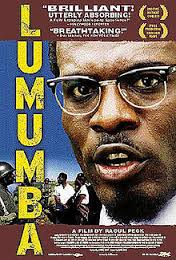
Haïti and Zaïre linked in Peck's Lumumba

 
Haïti and Zaïre share more than an umlaut.  They share a common language and a long history of suffering under sovereignty.  Specifically, they share Raoul Peck, a Haïtian director of the Belgian film Lumumba (2000), featuring the 2 month reign of Patrice Lumumba, before he was "disappeared" by the CIA.  It was filmed in Zimbabwe and Beira, Mozambique.  Lumumba's comrade-in-arms, Mobutu, would take over and rechristen the DRC as Zaïre.
 
Apparently, the Belgian Congo and subsequent Democratic Republic of the Congo felt it would be a wise decision to recruit French-speaking professionals from Haïti, since the Belgians had done little to create leadership from within the Congo native population.  Born in Port-au-Prince in 1953, Raoul joined his father in Léopoldville at 8 years of age, shortly after independence in June, 1960.  Peck attended schools in the DRC (Léopoldville), in the United States (Brooklyn), and in France (Orléans), where he earned a baccalaureate, before studying industrial engineering and economics at Berlin's Humboldt University. He spent a year as a New York City taxi driver and worked (1980–85) as a journalist and photographer before attending and receiving a film degree (1988) from the German Film and Television Academy Berlin (DFFB) in West Berlin.
 
Watching the film, I could not get over parallels between Lumumba and Aristide, both popularly elected and at odds with the U.S.

Wednesday, July 10, 2013

Heavenly Voices Eerily Similar in Chinese, Indian films


These are two profoundly beautiful films with truly extraordinary soundtracks.  Celebrated Director Zhang Yimou's  Flowers of War (2012) features lyrical coloratura soprano Chen Xiaoduo and the Allmänna Sången Choir (founded in 1830 in Uppsala, Sweden) in a song called "Heavenly Voice."  Listen to it here.  Danny Boyle's Slumdog Millionaire (2009) featured India's top female vocalist Suzanne D'Mello on Latika's Theme.  Though structurally different, these two theme songs are eerily resonant.

Thursday, July 4, 2013

California Dreamin' Informs Chungking Express


The Mamas & the Papas classic song California Dreamin' resonates in Hong Kong director Wong Kar-wai's film Chungking Express (1994).  WKW was heavily influenced by French New Wave (Truffaut, Godard, Rohmer, etc.) and it shows in the free form disregard for plot structure of his oeuvre and the emphasis of style over psychology.  This film, in the form of a diptych (two stories) filmed entirely within the claustrophobic confines of Hong Kong's infamous city-within-a-building housing debacle, Chungking Mansions (built in 1961) stars the Garboesque Brigitte Lin (who retired after this film) and Faye Wong (her first film, now a HK pop music star) who "performs" (her arms flailing behind the counter of the Midnight Express takeaway bar) a Cantonese cover version of The Cranberries' Dream.  The frequent pop culture references are reminiscent of the short stories of Japanese writer Haruki Murakami.  California Dreamin' is recognizable to  a global audience and commoditized as such.  Even the Del Monte pineapple tins are exemplars of American culture.

The film is about alienation and loneliness, paradoxical in that 4,000 tenants are crammed into the residence.

Saturday, June 29, 2013

Arendt's Banality of Evil Evident in Wong Kar-sai's Fallen Angels


"Banality of evil" is a phrase used by Hannah Arendt in the title of her 1963 work Eichmann in Jerusalem: A Report on the Banality of Evil.  Her thesis is that the great evils in history generally, and the Holocaust in particular, were not executed by fanatics or sociopaths, but by ordinary people who accepted the premises of their state and therefore participated with the view that their actions were normal.

Fallen Angels (1995) is Hong Kong director Wong Kar-Wai's best known film.  His films in collaboration with cinematographer Christopher Doyle are characterized by style over substance, as the plots are typically simple.  In my opinion, he has been influenced by Sergio Leone's late-1960s spaghetti westerns (an Ennio Morriconesque theme appears towards the end of the film) as well as producer Michael Mann's stylistic influence world wide in his Miami Vice episodes (1984-1989).  The show became noted for its heavy integration of music and visual effects to tell a story. It is recognized as one of the most influential television series of all time.

Hitman Wong Chin-Ming (Leon Lai) has a mysterious partner (Michelle Reis) who cleans his dingy apartment and faxes him blueprints of places he is to go hit in his murder for hire manner.  We are privy to his inner thoughts when he states "The best thing about my profession is there's no need to make decisions.  Who's to die, when, where.  It's all been planned by others."  Just like Nazi war time criminals, the Japanese Imperial Army in Nanking in 1937, the station masters in the Belgian Congo, etc., there percolates this notion that the perpetrators are taking orders and not subject to moral issues.

Saturday, March 9, 2013

Sergio Corbucci's The Great Silence is a Spaghetti Western that Slaps Hollywood in the Face !


Jean-Louis Trintignant
Klaus Kinski
 
Let's be clear here, nobody made Spaghetti Westerns like Sergio Leone.  He is the A-list.  Sergio Corbucci probably heads the B-list.  The Great Silence (1968) is a great Western built on an Ennio Morricone soundtrack.  It stars Jean-Louis Trintignant and Klaus Kinski and takes place in the 1899 blizzard in Utah.  Spoiler alert !  All the good guys die.  Nuff said.