Thursday, May 19, 2011

Terry Gilliam is Lost in La Mancha


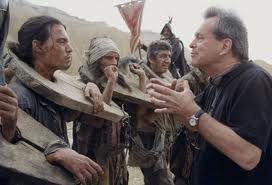
In 2002, documentary film makers Keith Fulton and Louis Pepe have a field day portraying director Terry Gilliam as a real life Don Quixote in his effort to make a modern version of the Cervantes epic, starring Johnny Depp. Benjamin Fernandez (Production Designer) notes how Gilliam can "see things we can't see," like windmills maybe ? The industry has a perception of Gilliam as a director out of control, especially after the financially ruinous movie The Adventures of Baron Munchausen (1988). Like Quixote who aims to change the world at age 50, Gilliam (61) sees this film as his own last hurrah, but reality wins over The Man Who Killed Don Quixote in the end. Plagued by flash floods, military fighter jet noise, and a herniated disc for actor Jean Rochefort (DQ), the film was ultimately abandoned, although Gilliam later bought it back from the insurance company.


Monday, May 2, 2011

Orson Welles' Don Quixote an Exercise in Tilting at Windmills


Orson Welles' Don Quixote was an exercise in futility (the Tilting at Windmills pun irresistible) to bring Cervantes' novel to the screen. Many have tried, some failures have even been documented, like Terry Gilliam in Lost in La Mancha. Welles' story is of great interest, but for readers of the book, the chronicler issue is perhaps most interesting.

Yes, there is a chronicler issue in Don Quixote. Cervantes chooses to act the role of historian in the book, rather than novelist. The representation of authorship in the novel is intriguing, since Cervantes intercedes early in the book (1st Part, Book 2, Chap 1) explains how the history of the famed knight has been cut off at this point. In the first 8 chapters, mention is made of an anonymous chronicler: "Who doubts, in the ensuing ages, when the true history of my famous acts shall come to light, but that the wise man who shall write it....And, thou wise enchanter, whosoever thou beest, whom it shall concern to be the chronicler of this strange history..." (1st, 1, 2).

In his Moorish travels the author has discovered in Toledo an old manuscript written in Arabic by an historian named Cid
Hamet Benengeli. Cervantes uses this as a device to ensure the objectivity of the storyteller, the author is a Moor, for an infidel would try very hard to understate the achievements of a Spaniard. This assures the reader that the history of Don Quixote is true and unexaggerated. "And if any objection be made against the truth of this, it can be none other that the author was a Moor; and it is a known property of that nation to be lying: yet, in respect that they hate us mortally, it is to be conjectured that in this history there is rather want and concealment of our knight's worthy acts than any superfluity; which I imagine the rather, because I find in the progress thereof, many times, that when he might and ought to have advanced his pen in our knight's praises, he doth, as it were of purpose, pass over them in silence; which was very ill done." In effect, the balance of Part I is based on the pretended discovery of a pretended translation of a pretended Arabian account.

When Orson Welles embarked in Mexico City in 1958 on his never ending project of filming Don Quixote, he would add a new dimension to the chronicler question, as film maker becomes chronicler explicitly. Welles was able to complete the scenes involving Francisco Reiguera (DQ) prior to the actor’s death in 1969 and Akin Tamiroff (SP). Welles also brought in child actress Patty McCormack (photo, note Bad Seed braids) to play an American girl visiting Mexico City. During her visit, she would encounter Welles (playing himself) and then meet Don Quixote and Sancho Panza. Delays forced her to drop out as she outgrew her role. Footage was shown at the Cannes Film Festival in 1986, one year after Welles died. In 1990, Spanish producer Patxi Irigoyen and director Jesús Franco acquired the rights to the extant footage of the Don Quixote project. Franco included footage of Welles filming in Spain, taken from a documentary he had made in the 1960s. Welles had not intended to appear in the film himself, other than as its narrator. The Irigoyen and Franco work premiered at the 1992 Cannes Film Festival as Don Quixote de Orson Welles.

The movie takes place in the contemporary era, the knight-errant and his squire befuddled by the modern contrivances of televisions, motor scooters, missiles, and movie cameras. Further, director Welles is featured in the film, albeit, posthumous. This recalls Cervantes' reference to his own book Galatea. In one scene Sancho earns some pocket money working for the film crew. In many ways, this is a postmodern version of the 400-year old relation between author and characters. Was Orson Welles conscious of this chronicler issue vis a vis Cid Hamet Benengeli et al.? We'll never know.

Tuesday, April 26, 2011

400 Years Later, Entrepreneurs Following Footsteps of Don Quixote's Squire

Sancho's Wife Ain't Buying it ! The final scene in Cervantes' Don Quixote (1st part, book 4, chapter 25) involves the return of the knight-errant and squire home. This is the most amazing corollary to the plight of the modern entrepreneur's wife you could hope to imagine ! Sancho's wife cuts to the quick:


At the news of this his arrival, Sancho Panza's wife repaired also to to get some tidings of the good man; for she had learned that he was gone away with the knight, to serve him as his squire; and as soon as ever she saw her husband, the question, she asked him was, whether the ass were in health or no ?

Sancho answered that he was come in better health than his master.

'God be thanked,' quoth she, ' who hath done me so great a favour; but tell me now, friend, what profit hast thou reaped by this thy squireship ? What petticoat hast thou brought me home ? What shoes for thy little boys ?'

'I bring none of these things, good wife,' quoth Sancho; 'although I bring other things of more moment and estimation.'

'I am very glad of that,' quoth his wife: 'show me those things of more moment and estimation, good friend I would fain see them, to the end that this heart of mine may be cheered, which hath been so swollen and sorrowful all the time of thine absence.'

'Thou shalt see them at home,' quoth Sancho, 'and therefore rest satisfied for this time; for and it please God that we travel once again to seek adventures, thou shalt see me shortly after an earl or governor of an island, and that not of every ordinary one neither, but of one of the best in the world.'

'I pray God, husband, it may be so,' replied she, 'for we have very great need of it. But what means that island ? for I understand not the word.'

"Honey is not made for the ass's mouth,' quoth Sancho; 'wife, thou shalt know it in good time, yea and shalt wonder to hear the title of ladyship given thee by all thy vassals.'

'What is that thou speakest, Sancho, of lordships, islands, and vassals?' answered Joan Panza (for so she was called, although her husband and she were not kinsfolk, but by reason that in the Mancha the wives are usually called after their husband's surname).

"Do not busy thyself, Joan,' quoth Sancho, 'to know these things on such a sudden; let it suffice that I tell thee the truth, and therewithal sew up thy mouth. I will only say thus much unto thee, as it were by the way, that there is nothing in the world so pleasant as for an honest man to be the squire of a knight-errant that seeks adventures. It is very true that the greatest number of adventures found out succeeded not to a man's satisfaction so much as he would desire; for of a hundred that are encountered, the ninety-and-nine are wont to be cross and untoward ones. I know it by experience, for I have come away myself out of some of them well canvassed, and out of others well beaten. But yes, for all that, it is a fine thing to expect events, traverse groves, search woods, tread on rocks, visit castles, and lodge in inns at a man's pleasure, without paying the devil a cross.'

Thursday, April 14, 2011

Parallax Views: Cardenio's Tale in Don Quixote Informs Belvaux's Trilogy


Cervantes wrote a very famous tale within Don Quixote, known as "Cardenio’s Tale" (1st Part, Book 3, Chap 13). Shakespeare later adopted it for a play of the same name. In brief, it is a story about Cardenio falling in love with Lucinda. Yet his friend, Don Fernando, isolates Cardenio from Lucinda, and marries her through some sleight of hand. Cardenio secretly watches the ceremony from a distant vantage point. Cardenio’s narrative presents problems because it is not exclusively his. He is not the only source for the story. His story is in part that of other characters in the book. The story is also fractured by the interrupted text presentation. Later, Dorothea relates details (1st Part, Book 4, Chap 1) of the same story as she intersects with Cardenio’s tale by way of Don Fernando (she was a former lover, also shorted by the marriage to Lucinda). As different characters relate different aspects of the story, the skewed viewpoints offer a way for the reader to gather more of the facts than the individual characters have themselves. When Dorothea relates her knowledge of the wedding ceremony, Cardenio is shocked to hear that the letter that was found on Lucinda when she fainted at the wedding ceremony was a declaration in her hand that she was already Cardenio’s wife (in principle). Dorothea watched Fernando reading it. Hence, Cardenio is not fully apprised of his own tale until he hears Dorothea’s version. Finally, Don Fernando joins the others, and tells his own version of the story (1st Part, Book 4, Chap 9).


This parallax view of events, as exploited in Don Quixote, often referred to as the first modern novel (1602) is fully utilized in film. Exactly 400 years later, The Belgian director, Lucas Belvaux has used this approach brilliantly in his 2002 Trilogy (On the Run, An Amazing Couple, and After the Life) of films (thriller, comedy, and melodrama), each taking place at the same time. Different characters in the 3 films keep swapping foreground and background roles. It is not until we’ve seen the final installment that we have full vision, it is only peripheral when viewing each film individually. This is a bold experiment in film that is brilliantly executed.

Saturday, March 5, 2011

Dhobi Ghat's Frustrated Lovers


Dhobi Ghat is a brilliant Indian "Indie" film directed by Kiran Rao, wife of Bollywood star Aamir Khan (who plans an understated Arun in the film). It is about the intersection of four lives, much in the flavor of the Paul Haggis film Crash (2004). Breathtaking photography of Mumbai in all its decay and vibrancy is reminiscent of Slumdog Millionaire. As in much Indian literature (The God of Small Things is the quintessential exemplar), the protagonists are foiled by their class (or lack of). A one-night stand between the beautiful New York-investment banker Shai (Monica Digra) and the emotionally remote artist Arun never gets traction. At the same time, the dhobi wallah (clothes washer) Munna (Prateik), a poor boy with dreams of Bollywood stardom, falls hopelessly in love with the sophisticated Shai. The dhobi wallah compound is a well known tourist stop in Mumbai.

In parallel, the postmodern essence of this movie is a film within a film. Arun moves into a flat in the Muslim section of the city, and discovers a video left in an armoire, belonging to the previous tenant. It is the diary of a videographer, whose piece opens the film, a young Muslim bride, Yasmin (Kriti Malhotra). Arun is transfixed by the videos and is inspired to paint based on what he discovers. As the videos unfold, he discovers her husband has been unfaithful, ultimately leading to a tragic ending. Unrequited love amongst characters with disparate roots is the theme. In the final scene, realizing he will never attain her, the dhobi runs to catch Shai's taxi to give her Arun's new address. Likewise, she crumbles the note.

Saturday, February 12, 2011

Catadores Find Dignity at Jardim Gramacho


Waste Land is a 2010 documentary by Lucy Walker documenting Brazilian artist Vik Muniz' art creations with the help of garbage pickers in Rio's Jardim Gramacho (the "Garbage Garden"), the world's largest landfill. As a youth in São Paulo, Muniz had the "good fortune" to be shot in the leg by a rich kid, who paid him off; he used the money to buy a ticket to America. It is Muniz' grand vision that creates treasure out of trash and restores great human dignity to these catadores (Portuguese for scavengers) as they take great pride in their artistic creations that are auctioned in London and exhibited at the Museum of Modern Art in São Paulo. Muniz fashions re-creations of famous paintings, including Jacques-Louis David's Death of Marat. The posed photographs are then re-created in giant Seurat-style pointillism with salvaged materials. In the end it is the elite world of art auctions that funnels monetary reward and recognition to these struggling workers.

Muniz' close rapport with six pickers is especially touching. Tiaõ is the head of the Association of Recycling Pickers of Jardim Gramacho. Muniz and his wife (his ex by the end of this three-year effort) debate the ethics of taking Tiaõ to London to witness the auction. There is concern that after seeing how the other half lives, he could never return. In the end he makes the trip and is overwhelmed with pride. This is a film that is much more about humanity than about garbage, much more about a culture of catadores than a culture of waste.


Friday, February 4, 2011

Art and Pornography Make Strange Bedfellows


9 Songs is a 2004 British film directed by Michael Winterbottom (The Killer Inside Me). The title refers to the nine songs played by seven different indie rock bands (Dandy Warhols, Primal Scream, Black Rebel Motorcycle Club, The Von Bondies, Elbow, Super Furry Animals, and Franz Ferdinand) and Michael Nyman (contemporary classicist) at Brixton Academy and other venues in London that complement the story of the film. The film is controversial in its depiction of unsimulated sex between its two co-stars, Kieran O'Brien and Margo Stilley, in a mainstream film that received a certificate for general release. The film is framed as a reminiscence from glaciologist Matt, while working in Antarctica, of his 12-month romance with American exchange student Lisa.

It is hard to imagine that the graphic sex scenes contributed artistically to the film's meaning, but a case can no doubt be made. One reviewer (Jim White) has commented that "this is not acting we see, this is activity." Ironically, despite the effort to portray a tender love story, the net effect is wholly unerotic. So what is the point ? While pornography strives to eroticize, this artistic film falls short in that arena. White makes the insightful point that film is too mechanical, intrusive, and voyeuristic a platform in comparison with literature. The film author is at a huge disadvantage, his mode of communication is literal, not literary.