Thursday, December 29, 2011

Old School Trumps New School in The Five Obstructions


The Five Obstructions is a 2003 Danish film by Lars von Trier and Jørgen Leth. The film is a documentary, but incorporates lengthy sections of experimental films produced by the filmmakers. The premise is that Lars von Trier has created a challenge for his friend and mentor, Jørgen Leth, another filmmaker. Von Trier's favourite film is Leth's The Perfect Human (1967). Von Trier gives Leth the task of remaking The Perfect Human five times, each time with a different 'obstruction' (or obstacle) given by von Trier.


Lars von Trier, whose own films combine harsh intimacy with jarring theatricality, professes great admiration for The Perfect Human, which may be why he wants to smash it, describing it as ''a little gem we are now going to ruin.'' Arbitrary constraints were conjured up by von Trier. He beckons Leth from his home in Haiti to reshoot the movie in Havana, with the proviso that no shot could last more than 12 frames, which translates into half a second of screen time. Leth turned the stuttering staccato of abrupt jump cuts into elegant syncopation. The next version had to be shot in ''the worst place on earth,'' which turned out to be Mumbai's red light district on Faukland Road. von Trier, disgusted by the results -- ''It's a marvelous film, but you didn't follow the rules'' -- punishes Leth by ordering him to go back and do it again, and then when this order is refused, to make ''a film without rules.'' After that he had to remake The Perfect Human as a cartoon, for which he enlisted the help of Bob Sabiston, the a Texas-based computer genius.


Lars von Trier sees himself as a maniacal psychoanalyst. His goal is clearly to shatter Leth's nearly superhuman composure, to wrench him out of longstanding habits and techniques and to break down his aesthetic and psychological defenses. It is amusing and rather gratifying to watch him fail, since his restless provocations are in the end no match for Leth's implacably passive-aggressive reserve. Their battle of wills climaxes with a fifth obstruction, in which von Trier has already made the fifth version, but it must be credited as Leth's, and Leth must read a voice-over narration from his own perspective but in fact written by von Trier. All of his meddling failed to produce the desired result, which was to force Mr. Leth, a chilly perfectionist, to make an imperfect film. This amounts to an admission of defeat on von Trier's part. At stake are two divergent ideas about what art should be: Leth values control, formal balance and arm's-length irony, while von Trier is interested in making a mess. This is the collision !


At the Berlinale 2010, Lars von Trier, Martin Scorcese and Robert De Niro announced plans to work on a remake of Scorsese's film Taxi Driver. The film will be made with same restrictions as were used in The Five Obstructions.

Friday, December 16, 2011

Bertolucci Takes a Postmodern Cue from Delillo


Bertolucci's 2003 film The Dreamers takes an intimate look at the evolving complex relationship between an American student visiting Paris (Matthew) and the twins Théo and Isabelle. They all fancy themselves as film buffs. Living large in an apartment all to themselves (parents on vacation), they isolate themselves from the growing tumult on the streets in May, 1968. The subplot relates to the ouster of beloved Henri Langlois, founder of the Cinémathèque Française.

Matthew tries to impress upon Théo the importance of the tumult outside their apartment. "There's something going on out there. Something that feels like it could be really important."


There is a brief moment in the film where Matt and Isabelle are walking on the street and notice a television in a storefront broadcasting the student riots. Ironically, they discover the reality of what is going on from the television, rather than through their apartment window. This is immediately reminiscent of the party scene in Delillo's Underworld, where multiple TV screens are playing the Zapruder film of Kennedy's assassination on continuous loop. Seeing it on TV makes it more real in a very postmodern fashion.

Sunday, November 6, 2011

Marc Anthony Yhap Steals the Show in The White Diamond


Werner Herzog, master film maker, has served up a delicious documentary filmed on location at Kaieteur Falls, Guyana in 2004. The film starts out on a technical note reviewing the history of air flight, especially airships, and focuses on Graham Dorrington, a geeky aeronautical engineer who is a lecturer at Queen Mary, University of London, who is planning to test a tear-drop shaped airship above Guyana's jungle canopy. Dorrington becomes quite the humanist in front of Herzog's camera as he recounts the tragic death in Sumatra of his colleague cinematographer Dieter Plage. Bellow aficionados will recognize the scientist/humanist dichotomy explored in The Dean's December, yet in Dorrington, these two world views share the same brain. The scenes of Kaieteur are spectacular, especially watching the millions of white-tipped swifts (Aeronautes montivagus) which roost in inaccessible caves behind the falls. At one point Herzog is able to film the secret nesting place of the huge swift colony. Herzog shows the local chief explaining that showing the nesting grounds to others will bring disaster--and then leaves the actual footage of the nests out of the picture! There is anawesome scene in this film where Herzog shoots the upside-down reflection of the mighty waterfall in a falling drop of rain. The soundtrack by Ernst Reijseger is haunting.


Well, this is all very well, but a Rastafarian diamond miner by the name of Marc Anthony Yhap steals the show. He is the sole survivor in Guyana of an extended family that has emigrated to Malaga, Spain. In some ways, the film is a call home from a man who misses his family. Dorrington feels he exudes great wisdom. His innocent words are magical.


That is a beautiful view. It has a sunset and there is the balloon just floating
around aimlessly. Yeah, it's beautiful. It's just fantastic. I'm so fortunate
enough to witness something of a gem. I'm a miner mostly, and this is like a
diamond. Nice big diamond. Yeah, I love this. This is cool. This is real cool.
There is this big white diamond just floating around in the sunrise. It's
good.


Wow, I would like to use this craft to fly up to them, yeah. Even if it takes a whole year, months. I would love to have this craft to fly to them. Maybe land on the rooftop, give them a surprise. Yeah, it would be beautiful there, for me to be in the aircraft early in the morning. There is Marc Yhap at their doorstep saying, 'Hello, good morning.'


Monday, July 4, 2011

Abbot of Sponheim's 1492 "In Defence of Scribes" Foreshadows the Death of Liner Notes


Soon after Gutenberg's invention of movable type, the Abbot of Sponheim, Johannes Trithemius, wrote a tract in 1492, called In Defence of Scribes, in which he urged that the scribal tradition be maintained because the very act of handcopying sacred texts brought spiritual enlightenment. Unfortunately, his message was severely compromised when he had the book set in movable type so his message could be spread quickly and cheaply. This incident is mentioned 500 years later in Clay Shirky's Here Comes Everybody ( a title taken from Joyce's Finnegans Wake). Jefferies (The Guardian) comments that some irony lurks in Shirky's production of a traditional book that is hardly an exemplar of the mass collaborations that are his book's subject. Maybe this can be coined "Pulling a Sponheim."

More interestingly, this loss of the scriveners' trade highlights a more modern loss to audiophiles in the transition to file sharing of MP3 music files, sans artwork, sans liner notes. What would Sergeant Pepper's Lonely Hearts Club Band be without those liner notes ? This MP3-driven takeover was a classic example of good enough is good enough. Today's youth do not think in terms of buying a physical object that contains a finite number of songs arbitrarily selected by someone else. And that is a sad loss for the art of music.


Sunday, July 3, 2011

Mexico City Classes Clash in Bizarre Battle in Heaven


Mexico City film director/provocateur Carlos Reygadas entered this film into the 2005 Cannes Film Festival. It is a serious art film, with sexuality so real it borders on the surreal. Romney (The Independent) says "if only because the film is so outré that it seems closer to modern art than to any usual form of narrative cinema. It's almost too damn weird to be a film."

Marcos (a lead actor of exceptional unsightliness) is a security guard and a working class chauffeur working for a retired General, but has a few issues, not just that he is having sex with the General's daughter Ana. Btw, Ana gets her kicks working in the sex trade. You see, he and his very obese wife, Berta, have just learned that a neighbor's baby they kidnapped, accidentally died. That this mere fact is passed over so easily may be the most shocking aspect of the film. It's just a matter of time before Marcos comes clean with plans to turn himself in to the police, he already admitted his problem to Ana. Well, it makes sense then that he must kill her, and effectively dies himself while participating in a pilgrimage to the Basilica in honor of the Lady of Guadalupe. That's the story, fair enough.

But what makes this film interesting is the urban backdrop of Mexico City and the clinical treatment of rather mundane quotidinal carnal appetites among the characters. Does Reygadas have contempt for his actors ? It is hard to imagine they were chosen for anything besides their physical appearance. There is a very tender sex scene between Marcos and Berta, but due to their hippopotamus-like dimensions, it is more than totally bizarre. In a later sex scene between Marcos and Ana, the camera slowly pans through 360 degrees, implying all the city's problems come haunting the characters in that stark room. The improbable mismatch of body types strains the imagination (pardon the photo, I could not resist).


Thursday, May 19, 2011

Terry Gilliam is Lost in La Mancha


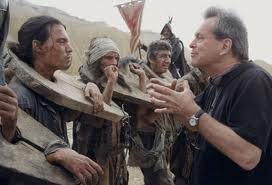
In 2002, documentary film makers Keith Fulton and Louis Pepe have a field day portraying director Terry Gilliam as a real life Don Quixote in his effort to make a modern version of the Cervantes epic, starring Johnny Depp. Benjamin Fernandez (Production Designer) notes how Gilliam can "see things we can't see," like windmills maybe ? The industry has a perception of Gilliam as a director out of control, especially after the financially ruinous movie The Adventures of Baron Munchausen (1988). Like Quixote who aims to change the world at age 50, Gilliam (61) sees this film as his own last hurrah, but reality wins over The Man Who Killed Don Quixote in the end. Plagued by flash floods, military fighter jet noise, and a herniated disc for actor Jean Rochefort (DQ), the film was ultimately abandoned, although Gilliam later bought it back from the insurance company.


Monday, May 2, 2011

Orson Welles' Don Quixote an Exercise in Tilting at Windmills


Orson Welles' Don Quixote was an exercise in futility (the Tilting at Windmills pun irresistible) to bring Cervantes' novel to the screen. Many have tried, some failures have even been documented, like Terry Gilliam in Lost in La Mancha. Welles' story is of great interest, but for readers of the book, the chronicler issue is perhaps most interesting.

Yes, there is a chronicler issue in Don Quixote. Cervantes chooses to act the role of historian in the book, rather than novelist. The representation of authorship in the novel is intriguing, since Cervantes intercedes early in the book (1st Part, Book 2, Chap 1) explains how the history of the famed knight has been cut off at this point. In the first 8 chapters, mention is made of an anonymous chronicler: "Who doubts, in the ensuing ages, when the true history of my famous acts shall come to light, but that the wise man who shall write it....And, thou wise enchanter, whosoever thou beest, whom it shall concern to be the chronicler of this strange history..." (1st, 1, 2).

In his Moorish travels the author has discovered in Toledo an old manuscript written in Arabic by an historian named Cid
Hamet Benengeli. Cervantes uses this as a device to ensure the objectivity of the storyteller, the author is a Moor, for an infidel would try very hard to understate the achievements of a Spaniard. This assures the reader that the history of Don Quixote is true and unexaggerated. "And if any objection be made against the truth of this, it can be none other that the author was a Moor; and it is a known property of that nation to be lying: yet, in respect that they hate us mortally, it is to be conjectured that in this history there is rather want and concealment of our knight's worthy acts than any superfluity; which I imagine the rather, because I find in the progress thereof, many times, that when he might and ought to have advanced his pen in our knight's praises, he doth, as it were of purpose, pass over them in silence; which was very ill done." In effect, the balance of Part I is based on the pretended discovery of a pretended translation of a pretended Arabian account.

When Orson Welles embarked in Mexico City in 1958 on his never ending project of filming Don Quixote, he would add a new dimension to the chronicler question, as film maker becomes chronicler explicitly. Welles was able to complete the scenes involving Francisco Reiguera (DQ) prior to the actor’s death in 1969 and Akin Tamiroff (SP). Welles also brought in child actress Patty McCormack (photo, note Bad Seed braids) to play an American girl visiting Mexico City. During her visit, she would encounter Welles (playing himself) and then meet Don Quixote and Sancho Panza. Delays forced her to drop out as she outgrew her role. Footage was shown at the Cannes Film Festival in 1986, one year after Welles died. In 1990, Spanish producer Patxi Irigoyen and director Jesús Franco acquired the rights to the extant footage of the Don Quixote project. Franco included footage of Welles filming in Spain, taken from a documentary he had made in the 1960s. Welles had not intended to appear in the film himself, other than as its narrator. The Irigoyen and Franco work premiered at the 1992 Cannes Film Festival as Don Quixote de Orson Welles.

The movie takes place in the contemporary era, the knight-errant and his squire befuddled by the modern contrivances of televisions, motor scooters, missiles, and movie cameras. Further, director Welles is featured in the film, albeit, posthumous. This recalls Cervantes' reference to his own book Galatea. In one scene Sancho earns some pocket money working for the film crew. In many ways, this is a postmodern version of the 400-year old relation between author and characters. Was Orson Welles conscious of this chronicler issue vis a vis Cid Hamet Benengeli et al.? We'll never know.